
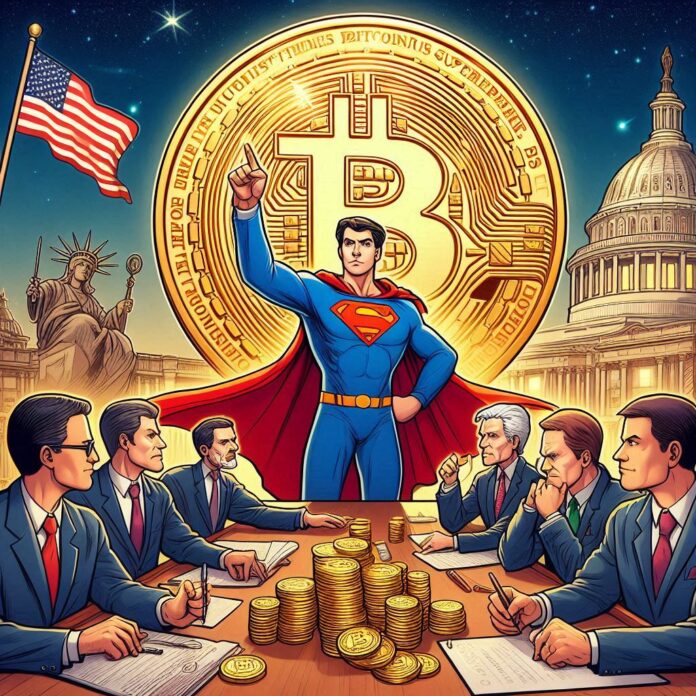
The US wants to become a “Bitcoin superpower.” Numerous steps have already been taken to pave the way. A look at the conflicts of interest.
Before his election as US President, Donald Trump delighted the tech and crypto community with numerous promises and won them over to the electoral boat. With his announcement to make the US the “Crypto Capital” of the planet, Trump planted the seeds of high hopes in the crypto industry.
Did Trump just promise, or did he deliver?
The US President has delivered, at a breathtaking pace. Trump’s crypto-friendly stance is expressed in numerous decrees and measures. To name just a few examples:
All key government and regulatory positions in the financial sector have been filled by crypto-friendly representatives. Several newly formed task forces are addressing issues that are intended to continuously pump fresh fuel into the crypto industry’s high-speed gears. The first Crypto Summit in the White House has taken place. Trump has paved the way for the government’s Bitcoin reserve.
All of this actually sounds pretty good; it could advance the crypto industry, and Bitcoin in particular. With so much manna for the crypto scene, the question arises: Are there any downsides and side effects?
Who benefits from the renewed crypto fireworks in the US?
If all these and other measures are focused on the goal of strengthening the US’s role in the crypto sector and opening up new and fair savings and earnings opportunities for the population, this suggests noble motives and intentions.
However, if the intentions are more to dominate the crypto markets through sheer size, the decentralized concept of Bitcoin and other cryptocurrencies could be undermined. Furthermore, if the doors are opened primarily to large tech players who view the masses as sources of capital for their own profits, then something is going terribly wrong in the long run.
Whether the presidential crypto initiatives in the US will take one path or the other remains to be seen. What is already becoming apparent today: conflicts of interest are at play.
Trump family heavily involved in the crypto circus
Shortly before Trump’s election as president, the industry reacted with irritation to the Trump Coin, which was issued by World Liberty Financial (WLFI). A meme coin whose sales are said to have brought WLFI $550 million into its coffers so far.
World Liberty Financial is a DeFi project launched two months before the US elections by Donald Trump, his sons, and other family-affiliated founders. A project, “Inspired by Donald J. Trump,” that is dominated by the Trump family.
WLFI’s mission sounds good: “We are leading a financial revolution by breaking the stranglehold of traditional financial institutions and returning power where it belongs: in your hands.”
However, the aforementioned parties contributed – sometimes at considerable losses – to increasing the wealth of the coin’s issuers through the purchase of Trump coins.
While the Trump coin shot up to almost $70 due to massive purchases shortly after its release, it has since plummeted to around $10.
World Liberty Financial remains on the ball – or rather, on the coin
Shortly after taking office, Donald Trump put all activities related to crypto-dollar initiatives in the US on hold and officially banned CBDCs. This is intended to promote stablecoins that support the US dollar.
Does this mean a boost for private stablecoin players in the market, such as market leader Tether or Circle’s USD Coin (USDC)? Possibly – but perhaps not.
The family and friends company WLFI has announced its own stablecoin, the USD1. This digital token is pegged 1:1 to the US dollar and is intended to be fully backed by reserves such as US Treasury bonds, dollar deposits, and other liquid assets. Details on the USD1 stablecoin can be found here.
These and other announcements don’t read as if the USD1 wants to settle for a niche market. The USD1 is bursting into a growing and highly profitable market of dollar-based stablecoins. And the USD1 is the first and only presidential stablecoin – albeit privately managed and driven by the Trump clan.
In other words, the Trump family is establishing itself as a provider in a crypto market whose laws are set by the head of the family and have massively adjusted since taking office in favor of Bitcoin, stablecoins, and cryptocurrencies in general.
The Agenda of the Trump Media & Technology Group
The Trump Media & Technology Group Corp. (TMTG), the operator of Trump’s own social media platform, Truth Social, also has new plans. The company announced a partnership with the crypto exchange Crypto.com a week ago.
The purpose of this collaboration is to launch a series of ETFs and other products under the Truth.Fi brand. So, TMTG is also becoming active in the crypto space. Here, too, it’s safe to assume that TMTG doesn’t intend to be stingy.
In the case of World Liberty Financial and the Trump Media & Technology Group, potential conflicts of interest are obvious. Politics, presidential power, and the private sector are being merged in a way never seen before.
This, however, doesn’t seem to bother anyone in Washington. At least the Trump family’s private crypto initiatives have not encountered any significant headwinds so far. Under the banner of “Make America Great Again,” the boundaries of what is possible have apparently been massively expanded, even in sensitive areas.