

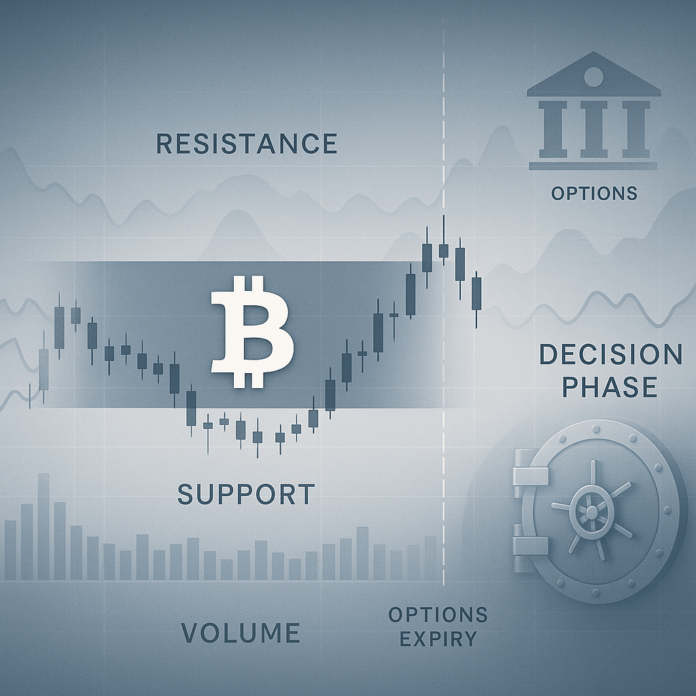
Bitcoin is entering a critical decision phase toward the end of the year. Price movements have narrowed, volatility has declined, and uncertainty remains elevated. Following the strong autumn rally, the market has transitioned into a tight trading range as investors weigh weaker liquidity, regulatory noise, and mounting technical resistance. At the core lies a key question: Is this consolidation merely a pause before the next major trend, or the early stage of a deeper correction?
Technical Setup: Pressure From Above, Support Below
From a technical perspective, Bitcoin currently appears compressed. After peaking near $125,000 in October, price action has cooled significantly, with Bitcoin now trading around $92,500, clearly below its 50-day moving average. A decline of more than 10% over the past 30 days and a drawdown of nearly 26% from the 52-week high highlight how much of the autumn rally has already been retraced.
Several short-term resistance zones are limiting recovery attempts. Levels between $92,000 and $95,000 have repeatedly acted as barriers, as short-term moving averages and clustered sell orders from active traders converge in this range. Until these zones are convincingly reclaimed, the technical picture remains under pressure.
On the downside, support between $88,000 and $90,000 has come into focus. The Relative Strength Index (RSI) at 38 does not yet signal extreme oversold conditions, but it reflects fading buying momentum. The noticeably lower volatility compared to the sharp swings seen in autumn reinforces the current wait-and-see posture: the market is moving, but without conviction.
On-Chain and Derivatives Data: Waiting for a Catalyst
On-chain and derivatives metrics paint a more nuanced picture beneath the relatively calm price action.
Exchange Trading Volume:
Spot trading volumes on centralized exchanges have declined markedly, with reports indicating roughly 20% lower daily volume. This aligns with the ongoing consolidation phase, as neither buyers nor sellers are pushing aggressively.
Options Expiry:
A large batch of Bitcoin options with a notional value exceeding $23 billion is set to expire later in December. Such expirations often serve as inflection points, as traders rebalance hedges and strategies. The current stagnation may partly reflect larger players waiting for this event before committing to new positions.
Mining Metrics:
Bitcoin’s hashrate and network difficulty remain elevated, underscoring the resilience of the mining infrastructure. However, declining prices since October have compressed miner margins. At this stage, there are no clear signs of forced capitulation, but operational efficiency is becoming increasingly important.
Together, these factors suggest significant underlying activity, even if the price itself remains range-bound.
Institutions, ETFs, and Ecosystem Activity
Fundamentally, the Bitcoin ecosystem remains active despite the lack of directional price momentum.
Corporate Treasuries:
Large publicly listed companies holding Bitcoin are not facing price levels that fundamentally challenge their long-term strategies. While the aggressive accumulation seen earlier in the year has slowed, there is also no evidence of meaningful distribution. This absence of heavy selling is helping to stabilize sentiment.
Spot Bitcoin ETFs:
Flows into physically backed Bitcoin ETFs present a mixed picture, but on balance suggest gradual accumulation that could extend into 2026. Institutions such as Standard Chartered have adjusted year-end targets toward $100,000, modestly above current levels, while acknowledging recent macro headwinds. The long-term thesis continues to rest on ETFs as a primary access point for institutional capital.
DeFi and Layer-2 Solutions:
At the same time, Bitcoin’s utility beyond simple buy-and-hold strategies is expanding. Through Layer-2 networks, wrapped Bitcoin products, and BTC staking protocols, long-term holders are increasingly generating yield instead of selling their assets. This trend effectively removes a portion of supply from the open market as long as investor conviction holds.
Macro, Regulation, and Market Sentiment
Macroeconomic factors remain a dominant influence. Shifting expectations around U.S. interest rate policy for early 2026 are weighing on risk assets, including cryptocurrencies and growth equities. As a result, fresh capital inflows into the crypto sector have slowed.
On the regulatory front, the U.S. Securities and Exchange Commission continues to act as a source of uncertainty. While recent comments have caused short-term volatility, larger market participants appear to have largely priced in the current regulatory environment. Liquidity conditions, interest rates, and economic data are currently seen as more decisive drivers.
Sentiment indicators such as the Fear & Greed Index have moved away from October’s euphoric levels toward a more cautious, mildly pessimistic zone. This shift helps explain why pullbacks are being absorbed rather than aggressively bought.
Outlook for the Coming Weeks
Two technical levels are likely to define the near-term outlook. A confirmed daily close below $89,000 could open the door to a correction toward the $80,000–$85,000 range. Conversely, a decisive reclaim of the $94,000 level on strong volume would ease technical pressure and re-establish upside momentum.
With a major options expiry approaching and interest rate expectations in flux, the current low-volatility environment is unlikely to persist indefinitely. How macroeconomic signals, regulatory developments, and large-holder behavior interact around the $88,000–$95,000 zone will be critical in determining whether Bitcoin enters 2026 with tailwinds—or renewed resistance.
[newsletter_form lists="1"]