
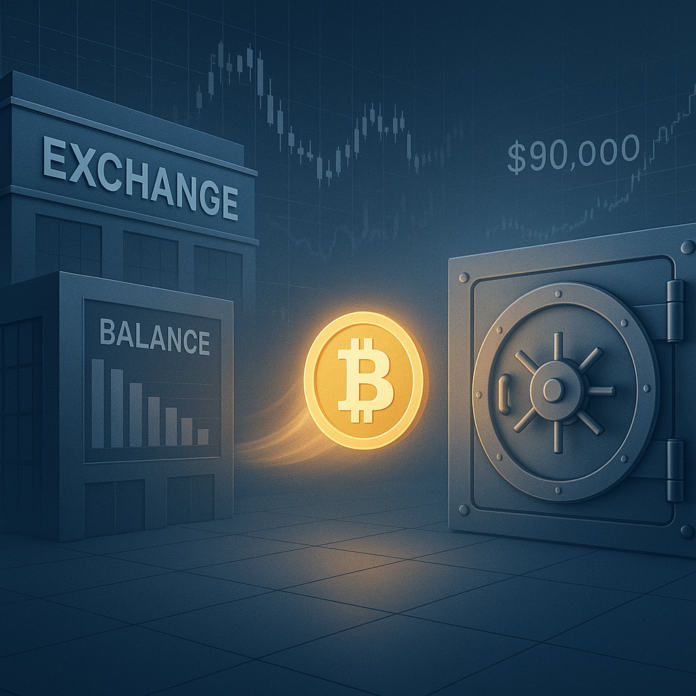
Bitcoin slipped below the $90,000 mark once again on Sunday evening, while centralized crypto exchanges continue to experience a sharp decline in BTC reserves. Exchange balances are now at their lowest level since autumn 2018, highlighting a significant shift in investor behavior.
According to recent on-chain data from analytics firm CryptoQuant, investors have withdrawn more than 196,000 Bitcoin, worth approximately $17.4 billion, from major exchanges such as Binance, Coinbase, and Kraken over the past three months. This accelerates a trend that first began gaining momentum earlier this spring.
On September 14, centralized exchanges collectively held around 2.952 million BTC. That figure has since fallen to approximately 2.755 million BTC. As a result, only 13.1% of all Bitcoin ever mined is currently stored on centralized exchanges. At first glance, this suggests that a growing number of investors are embracing the long-standing cypherpunk principle: “Not your keys, not your coins.”
Commenting on the declining Bitcoin reserves at Binance, a recent CryptoQuant report stated:
“When markets rise, long-term holders and large investors tend to move BTC from exchanges into cold wallets, reducing potential selling pressure.”
This behavior is typically associated with strong market conditions and is often interpreted as a sign of confidence rather than fear—raising the question of whether the current trend should be viewed as bullish.
However, an alternative explanation is gaining traction. Crypto-friendly regulatory developments in the United States are encouraging more traditional financial institutions to offer proprietary custody solutions. At the same time, Bitcoin treasury companies such as MicroStrategy, along with U.S. spot Bitcoin ETFs, have accumulated hundreds of thousands of BTC since the beginning of the year. These holdings are generally stored outside of traditional exchange infrastructure.
As a result, declining exchange balances do not automatically imply an imminent “supply shock.” Bitcoin’s history shows that exchange outflows are not a reliable standalone predictor of price appreciation. In 2021, for example, large-scale withdrawals failed to prevent a sharp price collapse triggered by China’s crypto ban.
Still, for patient long-term investors, the current environment may be constructive. Historically, similar conditions have tended to support medium- to long-term price appreciation. What remains absent, however, is a decisive return of demand—both from retail participants and institutional investors. Until that demand re-emerges, Bitcoin is likely to remain vulnerable to consolidation and downside volatility despite tightening exchange supply.
[newsletter_form lists="1"]