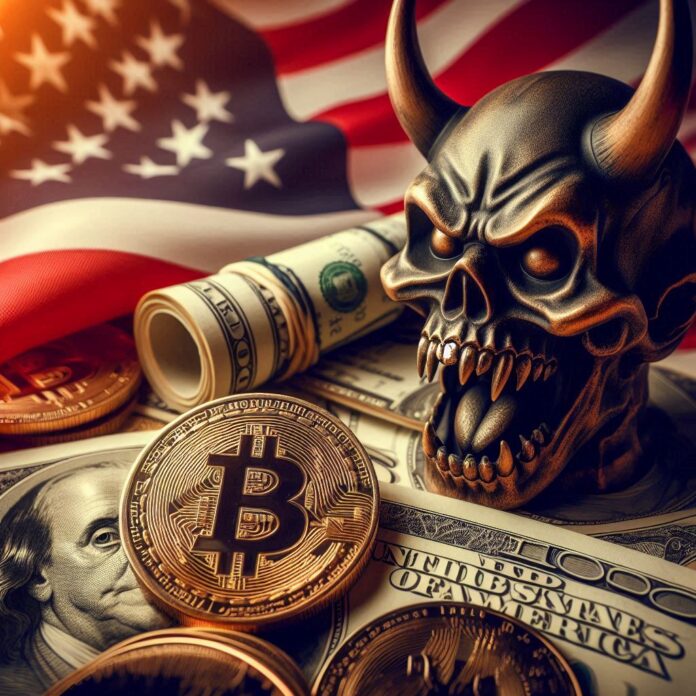
BlackRock CEO Larry Fink admits: Bitcoin poses a threat to the US dollar and could replace it as the world’s reserve currency – he made this position clear to BlackRock investors in the latest edition of his annual newsletter.
“The US has benefited for decades from the dollar being the world’s reserve currency. But that doesn’t have to last forever. If the US fails to get its debt under control and if deficits continue to grow, America risks losing that position to digital assets like Bitcoin,” Fink explained.
Parts of the crypto scene have hoped for years that fiat currencies will ultimately be completely replaced by cryptocurrencies. The fact that Larry Fink, a former major opponent, occasionally considers this fate a possibility is certainly a milestone in the history of cryptocurrencies.
As recently as 2017, Fink had labeled Bitcoin a tool for money laundering. Over the following years, he increasingly distanced himself from this position until, under his leadership, BlackRock launched a Bitcoin ETF in the US in January 2024, which achieved resounding success.
In his circular, he also made further concessions to the crypto industry. For example, he described decentralized finance as a valuable innovation.
“I am not, of course, against digital goods. But two things can be true simultaneously: Decentralized finance is an extraordinary innovation. It makes markets faster, cheaper, and more transparent,” Fink writes.
“Yet that same innovation could undermine America’s economic advantage if investors begin to view Bitcoin as a better bet than the U.S. dollar,” he continued.
Blockchain will revolutionize investments
The enormous potential of blockchain technology is far from being fully exploited, explains the BlackRock CEO. In the future, blockchain will be able to revolutionize investments across the board – through tokenization.
“Every stock, every bond, every fund – every asset – can be tokenized. If this is the case, it will revolutionize investing. Markets wouldn’t need to be closed. Transactions that currently take days would be settled in seconds,” Fink outlined his vision.
“And billions of dollars currently blocked by settlement delays could be immediately reinvested in the economy, thus driving more growth,” he concluded.
Fink sees all of these elements as clear advantages. Tokenization also has a lot to offer in other ways. Investments could be significantly more considerate of democracy. Barriers to entry would be lowered – for example, through simpler systems, but also through lower entry prices that allow for fractionalization.
Shareholder voting could be more secure and location-independent, as the vote on the blockchain can be clearly assigned to a token. The token can be a tokenized share, which thus represents a stake in a company.
Thanks to tokenization, it is conceivable for private investors to enter highly profitable businesses that were previously only accessible to institutional investors.
[newsletter_form lists="1"]