
Markets are bracing for a critical week for Bitcoin as the Bank of Japan (BoJ) prepares to announce its next interest rate decision on December 18–19. With expectations heavily skewed toward a rate hike, macro analysts warn that Bitcoin could face renewed downside pressure driven by tightening global liquidity.
Macro strategists and prediction markets largely agree that Japan is on the verge of raising rates by 25 basis points. While such a move would directly impact Japanese bond markets, its ripple effects could extend to global risk assets, including Bitcoin and the broader crypto market.
Japan in Focus: Rate Hike Puts Bitcoin Liquidity Back in the Spotlight
On Polymarket, the probability of a BoJ rate hike currently stands at 98%, with only 2% expecting rates to remain unchanged. Among crypto analysts, sentiment toward Bitcoin has turned increasingly cautious, particularly as BTC has already slipped below the psychologically important $90,000 level.
If confirmed, the hike would push Japan’s policy rate to 0.75%, a level not seen in nearly two decades. While still low by global standards, the move is significant: for years, Japan has been the primary source of ultra-cheap capital fueling investments across global markets—including cryptocurrencies.
Institutional investors have long borrowed yen at near-zero rates and deployed that capital into higher-yielding assets such as U.S. equities, bonds, and Bitcoin—a strategy known as the yen carry trade. That trade is now under threat.
“For decades, the yen has been the number one funding currency to borrow and swap into other assets… this carry trade is now disappearing as Japanese bond yields rise rapidly,” wrote analyst Mister Crypto.
Should yields continue to climb, investors may be forced to unwind yen-funded positions, selling risk assets like Bitcoin to repay debt—potentially accelerating downside volatility.
Liquidity Fears: Does History Point to Another Bitcoin Shock?
This backdrop is driving heightened uncertainty across crypto markets. Bitcoin is currently trading near $88,956, down 1.16% over the past 24 hours. However, traders are less focused on the spot price and more on historical patterns following past BoJ rate hikes.
- March 2024: Bitcoin fell approximately 23%
- July 2024: BTC declined by around 25%
- January 2025: Bitcoin dropped more than 30%
Based on these precedents, many traders see a clear risk pattern emerging.
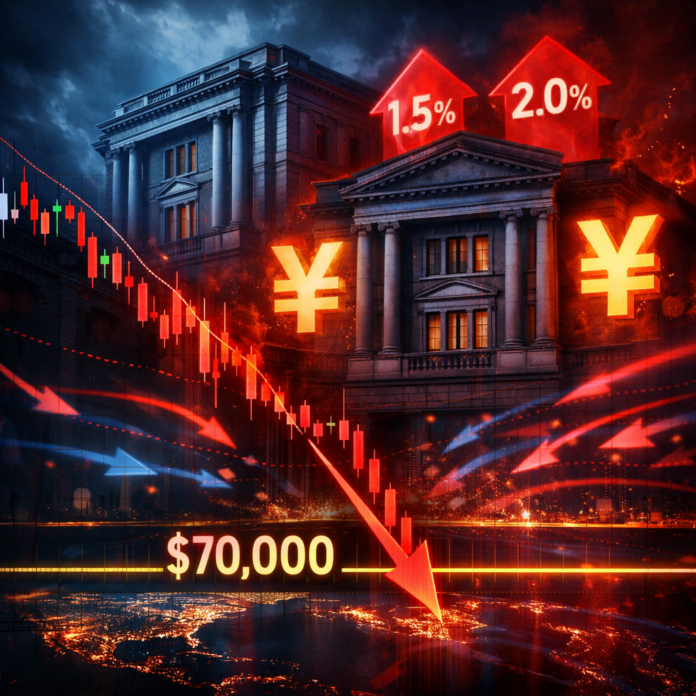
“Every time Japan hikes rates, Bitcoin drops 20–25%. Next week they raise rates to 75 basis points. If the pattern holds, BTC falls below $70,000 on December 19. Position accordingly,” warned analyst 0xNobler.
As a result, many market participants now view the Bank of Japan as the single largest macro risk for Bitcoin in the near term. A move toward the $70,000 level—roughly a 20% decline from current prices—is increasingly being discussed across crypto-focused social media.
Regime Shift or Liquidity Shock? Why Analysts Are Divided
Not all analysts are convinced that a BoJ rate hike will automatically trigger a Bitcoin sell-off. An alternative view argues that Japan tightening while the U.S. Federal Reserve cuts rates could ultimately prove bullish for crypto.
Macro analyst Quantum Ascend describes the situation as a regime change rather than a pure liquidity shock. Under this framework, Fed rate cuts would increase U.S. dollar liquidity and weaken the dollar, while cautious BoJ tightening would strengthen the yen without severely draining global liquidity.
The result, according to this thesis, would be a capital rotation into risk assets with asymmetric upside potential—an environment often described as a “sweet spot” for Bitcoin.
Short-term conditions, however, remain fragile. Analyst The Great Martis warned that bond markets are already applying pressure to the BoJ.
“This could mark the end of the carry trade and trigger chaos in equity markets,” he cautioned.
He also pointed to broad topping patterns in major equity indices and rising global yields as signs of mounting systemic stress. Bitcoin’s muted price action throughout December reflects this uncertainty, with analysts describing year-end conditions as unusually tense.
In particular, Daan Crypto Trades highlighted thin liquidity on decentralized exchanges and a lack of conviction among investors ahead of the holiday period.
With equity markets flashing sell signals, bond yields climbing, and Bitcoin’s historical sensitivity to Japanese liquidity shifts, the upcoming BoJ decision stands out as one of the most important macro catalysts for crypto heading into the new year.
Whether it triggers another sharp correction—or sets the stage for a post-volatility rally—will likely depend less on the rate hike itself and more on how global liquidity evolves in the weeks that follow.
[newsletter_form lists="1"]